Pasta Chef
- RTP: 95
- Max Win: x3750.00
- Betways: 25
- Volatility: High
- Game Type: Slots
- Release Date: July 16th, 2026
|
|
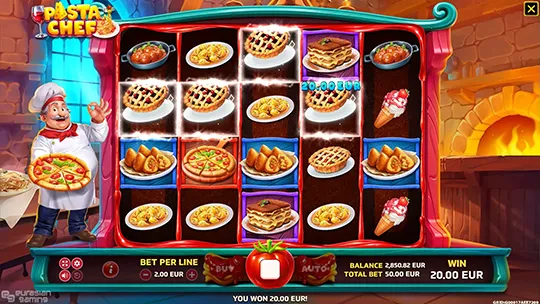
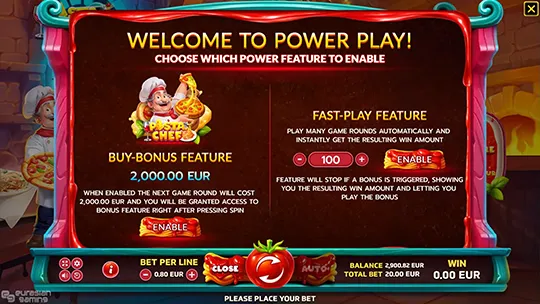
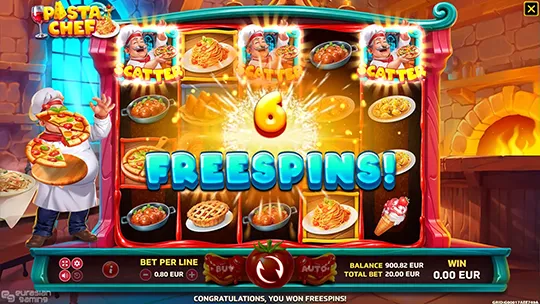
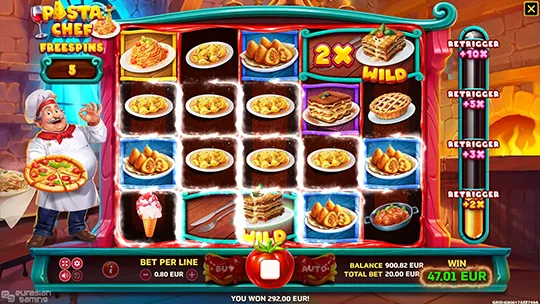
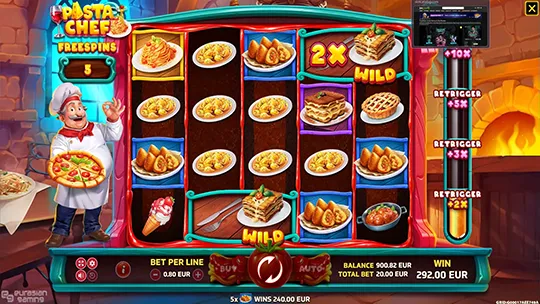
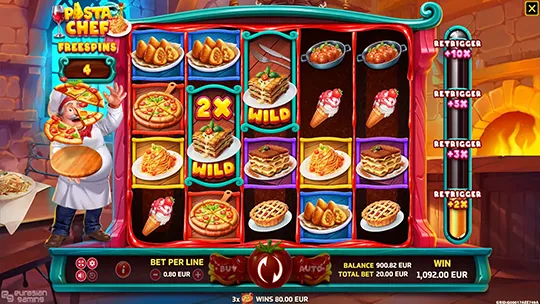
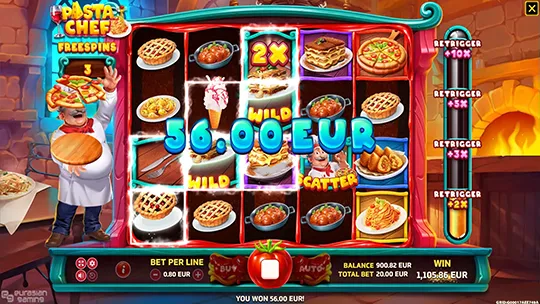
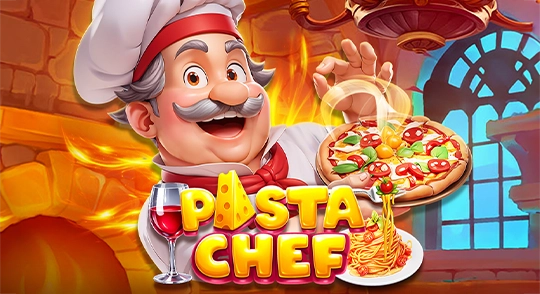
Pasta Chef is an Italian kitchen slot from Eurasian Gaming, played on a 5x4 grid with 25 paylines. A moustachioed chef in whites stands to the left of the reels holding a fresh pizza, a wood-fired oven glows away on the right with the brickwork lit orange behind it, and the whole scene is framed in the teal-and-red of a trattoria sign. The symbols are plates of food, served on white china against dark tiles: spaghetti, lasagne, meatballs in sauce, pizza, and – slightly incongruously – waffles and ice cream filling the lower end. There are no card royals at all, which keeps the grid looking like a menu rather than a slot with a theme applied over it. Wilds are the heart of the game, and they come in more forms than most slots bother with: sticky wilds that hold their position, walking wilds that move across the reels from spin to spin, respin wilds that trigger another go with themselves held in place, and random wilds that simply drop in on their own. Many of them arrive with a 2X multiplier attached, marked directly on the symbol. That variety is the game’s real content. A slot with one wild behaviour becomes predictable within a few dozen spins; here a wild landing raises an immediate question about which kind it is and what it will do next, and on a 25-line grid a walking wild carrying 2X crossing the board over several spins is worth following closely. Expanding symbols can fill an entire reel, and a gamble feature is on hand if you want to double up a win. The gamble is the traditional double-or-nothing arrangement – mathematically neutral, so it changes the variance of a session rather than the return. The chef himself is the scatter, and landing him across the reels opens the free spins. Using the character as the trigger rather than a generic scatter tile is a small touch, but it means the one symbol you are watching for is also the face of the game standing beside the grid. The free spins are built around a multiplier ladder running down the right-hand side of the screen, and it is the best thing in the game. It starts at 2X at the bottom and climbs through retrigger steps marked +3X, +5X and +10X, each labelled RETRIGGER on its own rung. The longer the round survives, the further up the ladder it climbs and the more everything pays. That structure changes what a retrigger means. In most slots winning extra spins simply extends a round at the same value; here each retrigger moves you to a higher rung, so a round that renews itself three times is not three times as long – it is three times as long and paying at a substantially higher multiplier. The ladder is visible throughout the round with your current position lit, so you always know what the next retrigger is worth. A Buy button sits next to the spin controls for players who would rather not wait for the chef to arrive. Worth noting is that buying in starts you at the bottom of the ladder like any natural trigger – you are purchasing the round, not a position on it. The interface shows the bet per line alongside the total, and the gap between them is large: a 0.80 per-line setting reads as a 20.00 total bet across the 25 lines. That is the most common way players in this format stake more than they intended, and both numbers sit on the same strip along the bottom, so it takes a glance to check. The numbers ask for some caution. The RTP is 95%, a full point below the 96% standard, and the volatility is high – a demanding combination that means longer dry stretches and less coming back over a session than a comparable game would return. Stakes run from 0.25 to 100 per spin. The maximum win is 3,750x the stake, which is moderate rather than headline-grabbing and only reachable through a long free spins round with the ladder well up. Given the 95% return, that ceiling is the compensation being offered, and whether it is proportionate is a judgement worth making before starting rather than afterwards. The four wild types are worth separating out, because they suit different moments and the game does not explain which is which until you have seen each a few times. A sticky wild is worth most when the board around it is already close to paying; a walking wild is worth most early, since it has more spins ahead of it to cross the grid; a respin wild pays off immediately by giving the current board a second attempt; and a random wild is simply a gift. Recognising which has landed changes whether the following spin is worth watching closely, and it is the closest this game comes to giving a player something to read. Eurasian Gaming is a smaller studio aimed principally at Asian-facing operators, and its catalogue leans towards bright, food-and-fortune themes with conventional mechanics underneath. Pasta Chef is a fair representative: the artwork is cheerful and specific, the feature set is assembled from familiar parts, and the one genuinely distinctive element – the retrigger ladder – is a good idea rather than a complicated one. It is not a studio pushing the format forward, but it builds tidily within it. The Italian kitchen theme is more coherent than most food slots manage, and the reason is the absence of card royals. Dropping A, K, Q and J onto a themed grid is the cheapest option available and it undercuts the setting every time; filling all twenty positions with plates of food instead means the board actually looks like the thing it is meant to be. The waffles and ice cream are a stretch for a pasta restaurant, but they at least belong to the same world as everything around them. It suits players who like wild-driven slots and enjoy a feature where retriggers genuinely improve the round rather than merely extending it – the visible ladder is a well-executed idea. Anyone who tracks RTP should weigh the 95%, and anyone who wants a busy base game will find that the wilds, for all their variety, still leave long stretches where nothing lands. You can try this game on 7gold Online Casino. There’s a unique casino bonus offer of 400% up to £1500 for a limited time. |