Plinko 2 Halloween
- RTP: 99
- Max Win: x10000.00
- Betways: 18
- Volatility: Low
- Game Type: Others
- Release Date: October 9th, 2025

|
|
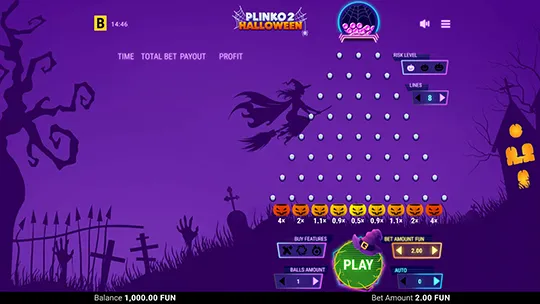
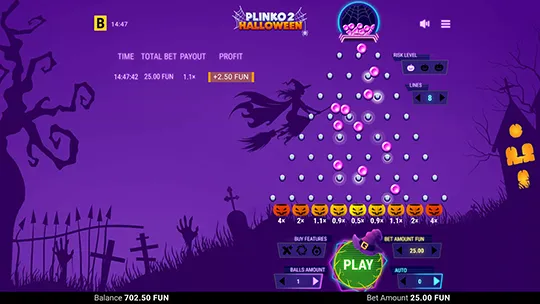
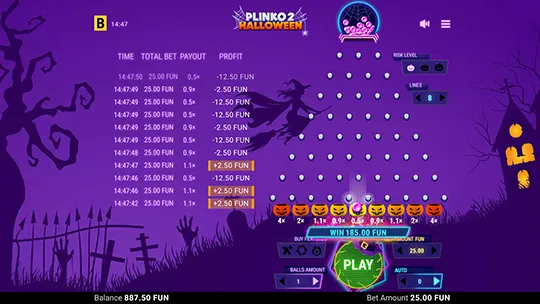
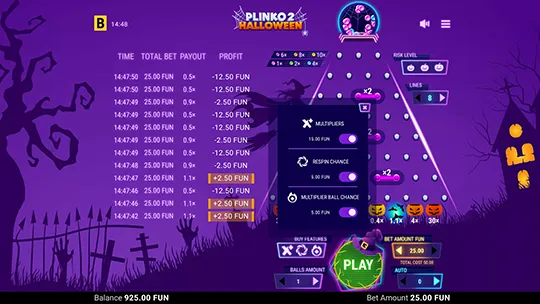
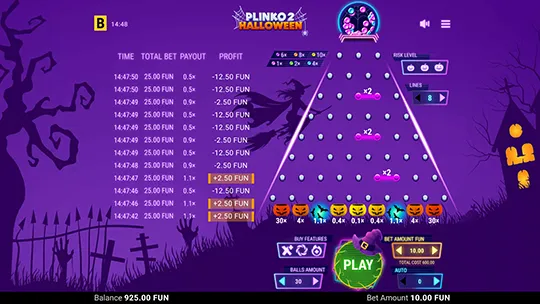
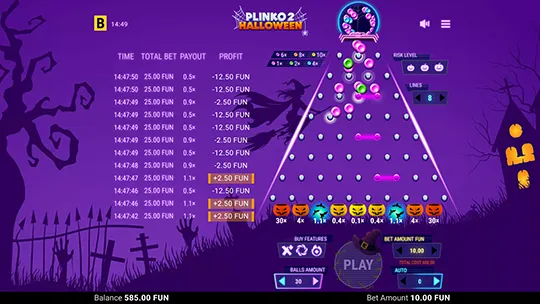
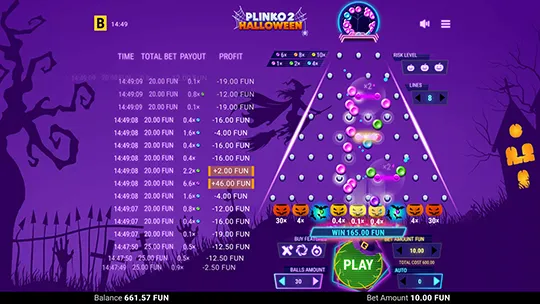
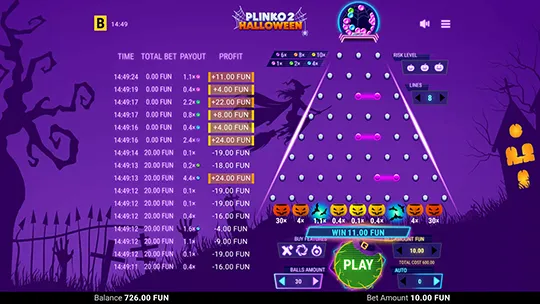
Plinko 2 Halloween OverviewPlinko 2 Halloween is not a slot. It is BGaming's take on the pin-board game: a ball drops from the top of a triangular field of pegs, bounces its way down, and lands in one of the payout buckets along the bottom. There are no reels, no paylines and no symbols. What it does have is a 99% RTP – three full percentage points above what a typical slot returns, and among the highest figures published for any casino game. That number alone makes it worth understanding. Theme and GraphicsThe Halloween dressing is applied lightly and well. The background is a purple graveyard at night with bare trees, leaning headstones, a hand clawing out of the earth and a haunted house glowing on the right. A witch on a broomstick hovers beside the pin field, and the payout buckets along the bottom are carved pumpkins – grinning wider or scowling depending on what they pay. Above the board sits a crystal ball. The pegs themselves are simple white dots, and the balls light up in pink, green and purple as they fall. How a Round WorksYou set a bet amount, choose how many balls to drop, and press PLAY. Each ball falls through the pegs, deflecting left or right at every level, and settles into a bucket whose multiplier is applied to that ball's stake. The demo runs at bet amounts of 2.00, 10.00 and 25.00 FUN. Because several balls can be in play at once, the interface also shows a total cost beneath the bet – drop thirty balls at 10.00 each and the round costs 300.00 before a single one lands. That distinction between bet amount and total cost is worth internalising before playing. The multipliers in the buckets apply to the individual ball's stake, not to the total, so a 30x result on one ball out of thirty is 30x of one-thirtieth of what you just spent. Risk Level and the Payout CurveThis is the control that matters. A Risk Level selector sits at the top right, and it reshapes the entire row of buckets. At the lower setting the demo shows the buckets reading 4x, 2x, 1.1x, 0.9x, 0.5x, 0.9x, 1.1x, 2x, 4x – symmetrical, with a shallow centre and modest edges. Most balls land near the middle, so most balls return roughly half the stake and the occasional outlier pays four times it. At the higher setting the same row reads 30x, 4x, 1.1x, 0.9x, 0.4x, 0.9x, 1.1x, 4x, 30x. The centre has got slightly worse and the outermost buckets have gone from 4x to thirty times the bet. That is the whole trade, laid out visibly: raising the risk level does not change how the ball falls, it changes what the extremes are worth. A ball reaching the outside edge is the same rare event at either setting; the difference is whether it pays 4x or 30x, and what the far more common central buckets cost you in the meantime. Lines and BallsA Lines selector beneath the risk control sets how many rows of pegs the ball passes through – the demo runs at 8. More rows means more deflections, a wider spread of outcomes, and more buckets to land in. It is the second half of the same decision the risk level governs: rows change the shape of the distribution, risk level changes what the tails of it are worth. The Balls Amount control at the bottom left ranges from a single ball up to 30 at once. Dropping thirty turns the board into a cascade of coloured lights and resolves thirty separate bets in one action – the demo catches a thirty-ball round paying 165.00 FUN in total. The Three Buy FeaturesRather than a single buy-bonus button, the game offers three independent toggles, each with its own price: Multipliers – 15.00 FUN. Multiplier tags appear on the board itself; the demo shows values of 2x, 3x, 4x, 6x, 9x and 10x floating among the pegs, applying to balls that pass through them. Respin Chance – 5.00 FUN. A chance for a ball to be dropped again. Multiplier Ball Chance – 5.00 FUN. A chance for a ball itself to carry a multiplier. Being able to switch these on separately is unusual and genuinely useful. Most games sell a bonus as a single package at a fixed price; here you can buy just the cheap 5.00 enhancements, or add the 15.00 multipliers on top, and see each cost reflected in the total before committing. The pricing also tells you which one the studio considers valuable. Multipliers cost three times what either of the other two do – and looking at the board with them active, with tags reading 6x, 9x and 10x scattered among the pegs, it is easy to see why. The History PanelDown the left-hand side the game keeps a running log with four columns: Time, Total Bet, Payout, Profit. Every ball is listed with its multiplier and the resulting gain or loss, colour-coded so wins stand out in orange. It makes the maths of the game impossible to hide from. A typical stretch in the demo reads 0.5x, 0.9x, 0.5x, 0.9x, 1.1x, 0.9x – six balls, four of them losing money, one roughly breaking even, one small win. That is exactly what a 99% return on a low-variance game looks like from the inside, and very few games are honest enough to print it on screen. RTP, Volatility and Max WinThe RTP is 99%, volatility is rated Low, and the maximum win is 10,000x the bet. That combination is unique to this format. A 99% return means the house edge is one percent – a quarter of what a typical slot takes – and the Low rating reflects a board where the overwhelming majority of balls land in the shallow central buckets. The ceiling of 10,000x exists because multipliers can stack onto a ball that reaches a 30x edge bucket, but the everyday experience is the history panel above: small losses, small wins, and a very slow drift. If you want a casino game that gives back nearly everything it takes and lets you see the arithmetic while it happens, this is one of the clearest examples on the market. You can try this game on AztecParadise Online Casino. There’s a unique casino bonus offer of 300% up to £2000 for a limited time. |