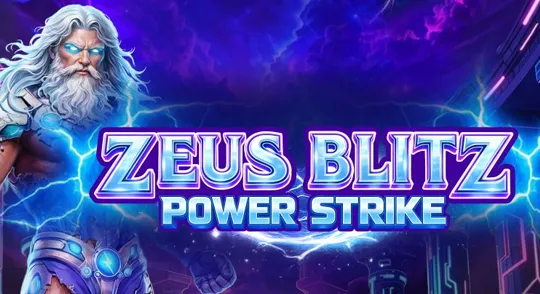
Zeus Blitz: Power Strike
- RTP: 96.52
- Max Win: x5000.00
- Betways:
- Volatility: High
- Game Type: Slots
- Release Date: July 21st, 2026
Features we found: bonus buy, multiplier, hold and win, jackpot
How we rate games
Every slot is scored on the same four criteria, using the game's published data: RTP (40%), maximum win potential (25%), bonus features described in our review (30%) and how recent the release is (5%). Our editors can adjust a score after playing the game. Missing data counts as neutral. The score reflects the game's numbers and features, not your chances of winning; slots are games of chance, so please play responsibly.
|
|
Zeus Blitz: Power Strike OverviewZeus Blitz: Power Strike by GameArt takes the king of the gods out of the marble temple and drops him into a neon storm. The Zeus standing beside the reels is not the usual white-bearded statesman – he is muscular and half-cybernetic, plated in electric blue and chrome, lit from within against crackling purple cloud. It is Greek mythology filtered through a synthwave album cover, and it commits to it completely. The 3x3 GridThe grid is a compact 3x3, framed in a glowing blue rectangle with the four jackpot values running along the top of the screen above it. Nine positions is very few, and the game makes no attempt to fill them with a conventional symbol set – there are no card royals and no line-based premiums doing the work here. Hold ‘n Win and the Lightning OrbsThat is because the game is built around a Hold ‘n Win round rather than around paylines. Lightning orbs carrying cash prizes and multipliers land on the grid and lock in place, and each new orb resets the respin counter back to three – so the round continues for as long as the orbs keep arriving and ends three spins after they stop. On a nine-position grid that question resolves quickly in both directions. A cold round is over in a few seconds; a hot one fills a substantial share of the board before it stops. There is very little middle ground, which is the clearest illustration of what high volatility means in practice. Multiplier OrbsThe multiplier orbs are what give the round its shape. They arrive carrying values – a pair of 6x orbs sat on the grid in one of our sessions – and they boost the cash values on the locked symbols rather than paying anything themselves. On a nine-position board a single 6x orb is touching a ninth of the entire playing area, so a modest collection can turn into a heavy payout in one respin. The small grid is the design decision that makes this work. On a 5x4 board a multiplier orb frequently lands somewhere irrelevant; here there is nowhere irrelevant to land, which is why a 3x3 Hold ‘n Win produces such abrupt swings compared with the same feature on a larger board. JackpotsFour fixed jackpots run along the top: Grand, Major, Minor and Mini. At a €10.00 stake they read €10,000.00, €1,500.00, €500.00 and €250.00 – which works out at 1,000x, 150x, 50x and 25x the bet. They scale with whatever you are staking: there is no minimum bet to qualify for the Grand, and at 0.10 and at 100 you are playing exactly the same game with the same odds. Buy BonusA Buy Bonus button sits on the left of the reels beneath Zeus, purchasing the Hold ‘n Win round outright for 75x the current stake. On a game where the base grid does almost nothing between features, that button is closer to the main entrance than a shortcut. It guarantees the round; it guarantees nothing about how many orbs land in it or what multipliers they carry. A bought round that produces three low-value orbs and stops is entirely possible. The expected return is built into the RTP like everything else, so buying compresses the session rather than improving it – not a better deal, only a faster one. RTP, Max Win and VolatilityThe RTP is 96.52%, comfortably above the standard, and the maximum win is 5,000x the bet – five times the Grand jackpot, which tells you the ceiling comes from a well-filled board with the multipliers stacking rather than from the top plaque alone. Stakes run from 0.10 to 100. The volatility is high, and on a game shaped like this that rating means something specific. There is no base game to speak of – nine positions and no paylines worth the name – so the balance simply drains between features. Everything hinges on the storm of orbs, and the stretches in between give you nothing back. That makes it an unusually pure version of the format. Most Hold ‘n Win slots wrap the feature in a functioning base game so the session has something to do while it waits; this one dispenses with the pretence entirely. Whether that reads as honest or as thin depends on how you feel about spinning a 3x3 grid. PresentationThe presentation is the reason to consider it anyway. The neon Zeus is a genuinely striking piece of character art, the orbs land with a satisfying weight, and the jackpot values glowing along the top of a mostly-black screen give the whole thing a focus that a busier game would lose. Zeus is the single most-used character in the industry, and making him look completely unlike every previous Zeus – including the marble version in GameArt’s own older Greek titles – is a blunt solution, and an effective one. GameArt’s catalogue runs from straightforward classic cabinets to elaborate feature slots, and Zeus Blitz sits at the experimental end of it. The neon-and-purple palette is closer to a modern arcade game than to anything on the mythology shelf, and the studio has plainly spent its effort where it shows. The interface is well judged for the format: the jackpot values across the top, the balance and bet along the bottom, and nothing in between except the grid and Zeus himself. On a phone it scales down cleanly, and the orbs stay legible at small sizes. Who It Is ForIt suits players who like Hold ‘n Win rounds and want the concentrated version – small grid, big multipliers, sharp swings – and who are comfortable buying in rather than waiting. It is best approached as a game to play in bursts rather than to settle into. Anyone who wants a base game that pays its own way should look elsewhere, because this one very deliberately does not have one. It is worth spinning the free demo on the left to get a feel for the game before committing real money. You can try this game on LuckyBar Online Casino. There’s a unique casino bonus offer of 300% up to £1500 for a limited time. |