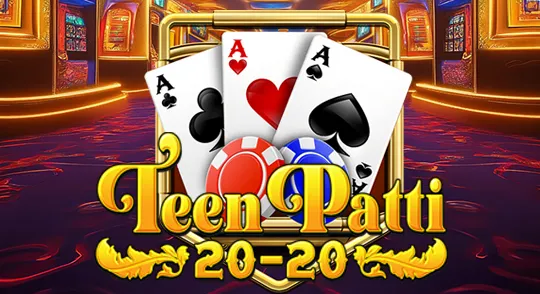
Teen Patti 20-20
- RTP: 96
- Max Win: x1000.00
- Betways:
- Volatility: Low
- Game Type: Slots
- Release Date: August 20th, 2025
|
|
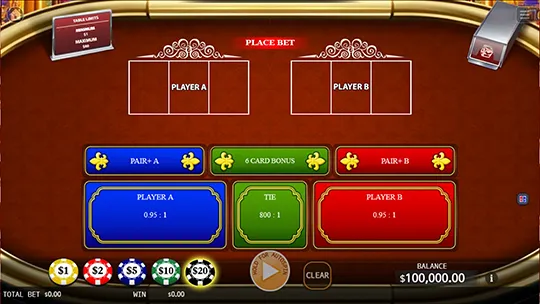
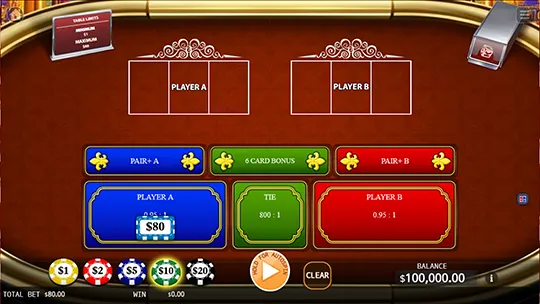
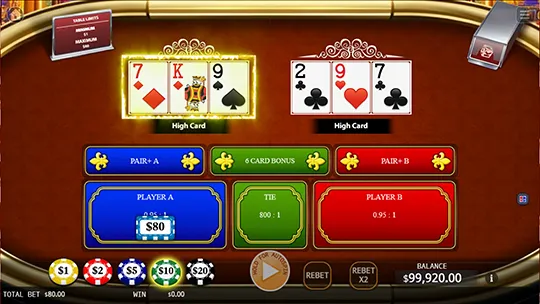
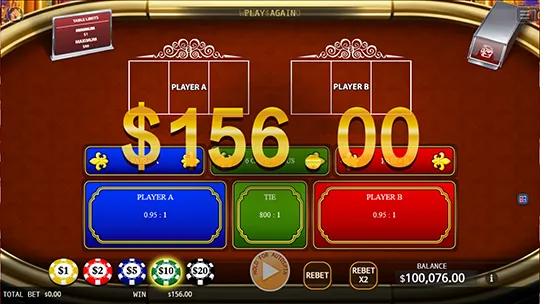
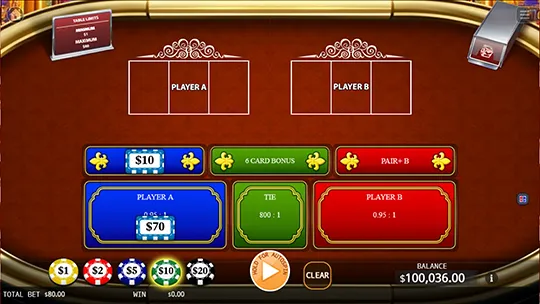
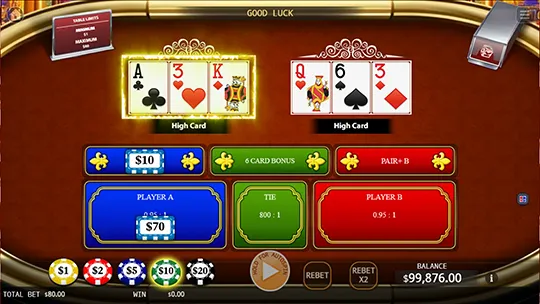
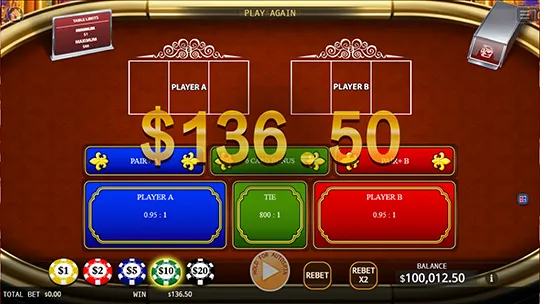
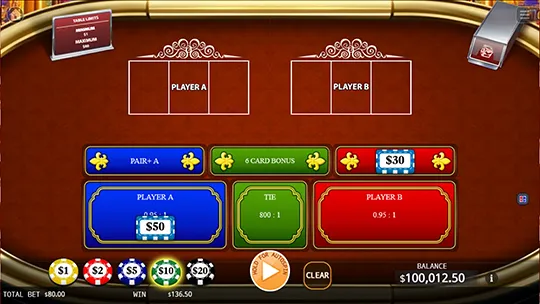
Teen Patti 20-20 OverviewTeen Patti 20-20 is not a slot. It is KA Gaming’s version of the Indian three-card game, dealt as a spectator table: two hands, Player A and Player B, are dealt three cards each, and you bet on which will win. There are no reels, no paylines and no bonus round. The odds are printed on the felt, and they are the whole game. Theme and GraphicsThe table is red baize inside a gold rail, photographed from above at a slight angle. A shoe sits in the top-right corner, a table-limits placard in the top-left, and the two hand positions are marked out in white line at the top of the felt. Beneath them the betting layout runs in three rows: a strip of side bets in blue, green and red, then the three main boxes, then the chip rail. Chips of $1, $2, $5, $10 and $20 line the bottom of the screen with CLEAR, REBET and REBET X2 controls beside the deal button. It is a plain, functional presentation with no animation beyond the cards turning. All figures below come from demo play at a $80 total bet. That restraint is deliberate and welcome. A three-card round resolves in a few seconds, and a game designed to be played dozens of times in a sitting cannot afford a thirty-second celebration. Everything on the screen is either a control or a number. The Three Main BetsThe odds are printed inside each box, which is more than many table games bother with: PLAYER A – 0.95 : 1. PLAYER B – 0.95 : 1. TIE – 800 : 1. The 0.95 is the detail that matters. Backing either hand pays less than even money: stake 100 and a winning bet returns 195, not 200. That five percent is the house’s cut, taken from every winning bet rather than from the stake up front – the same arrangement baccarat uses on its banker bet. The demo confirms it twice, exactly. An $80 bet on Player A returns $156.00 – the stake back plus 95 percent of it. A $70 bet on the same box returns $136.50, which is 70 plus 66.50. Both figures reconcile to the cent. There is no rounding in the player’s favour and none against. It is worth being clear about what a five percent commission costs over time. On a wager that wins roughly half the time, taking a twentieth of every win amounts to about two and a half percent of everything staked – which is why the game can quote a 96% return while offering what looks like an even-money bet. The Tie at 800 to 1The green box in the middle pays 800 : 1, and a number that large should always prompt the same question: how rare is the event? A tie here means both three-card hands finish with identical strength. In a game where the vast majority of hands are decided on high card, that requires a very specific coincidence – and 800 to 1 is the studio’s own estimate of how specific, minus its margin. What can be said without guessing at the probability is the shape of the bet. Backing a hand at 0.95:1 is a near-coin-flip with a small, steady drag; backing the tie is a lottery ticket. They are not variations on the same wager, and the eight-hundred-fold payout is there precisely because almost every round loses it. The Side BetsThree more boxes sit above the main row: PAIR+ A, 6 CARD BONUS and PAIR+ B. Pair Plus is the classic Teen Patti side bet: it pays on the strength of one hand on its own, regardless of whether that hand beats the other. The 6 Card Bonus combines all six dealt cards into a single poker hand. The demo shows them in use. One round has $70 on Player A and $10 on Pair+ A; another has $50 on Player A and $30 on Pair+ B. In the first of those the main bet won and the side bet did not – the hand was A-3-K, a high card with no pair – and the return was 136.50 rather than 156.00. That is the practical trap with Pair Plus. The main bet asks only which hand is stronger; the side bet asks the hand to be strong in absolute terms, and three cards frequently are not. Note also that you can back one hand and take the Pair Plus on the other, as the second of those rounds does. The two wagers are independent, which makes the layout more flexible than it first appears – and easier to over-commit to, since each box quietly adds to the same total bet. The Hands in PlayThe demo captures two complete rounds, and both are instructive about how the game usually resolves. In the first, Player A holds 7♦ K♦ 9♠ and Player B holds 2♣ 9♥ 7♣. The game labels both hands High Card, and A wins on the king. In the second, Player A holds A♣ 3♥ K♦ against B’s Q♣ 6♠ 3♦. Both are labelled High Card again, and A wins on the ace. Two rounds decided by the top card alone, with no pair on either side. That is the ordinary texture of three-card poker, and it is why the side bets pay what they do. The game labels each hand beneath the cards as it deals – High Card in both of these – so there is never any ambiguity about why one side won. On a game played this quickly, naming the hand is more useful than it sounds. RTP, Volatility and Max WinThe RTP is 96%, volatility is rated Low, and the maximum win is 1,000x the bet. Low is correct for the main bets and misleading for the rest. Backing Player A or B at 0.95:1 is about as gentle as a casino wager gets – close to an even chance, resolving in seconds, with a small fixed cut. The demo’s balance barely moves: 99,876 to 100,076 across the captures. The 1,000x ceiling belongs to the side bets, not to the main row. No amount of backing Player A will ever return more than 1.95 times the stake on a single round; the tie tops out at 800:1, which leaves the 6 Card Bonus as the only box on the table that can reach the quoted ceiling. It is a well-built, honest little table game. The odds are on the felt, the arithmetic reconciles exactly, and the rebet controls make a fast game faster. What it is not, despite where it sits in most casino lobbies, is a slot. You can try this game on 7gold Online Casino. There’s a unique casino bonus offer of 400% up to £1500 for a limited time. |